
Design System: Keep Enterprise Web and Mobile Products Consistent
TL;DR: A design system is a maintained set of design principles, reusable components, tokens and usage guidance for creating consistent product experiences. Inventory repeated patterns across real products. A component library alone is not a design system; guidance and maintenance make it dependable.
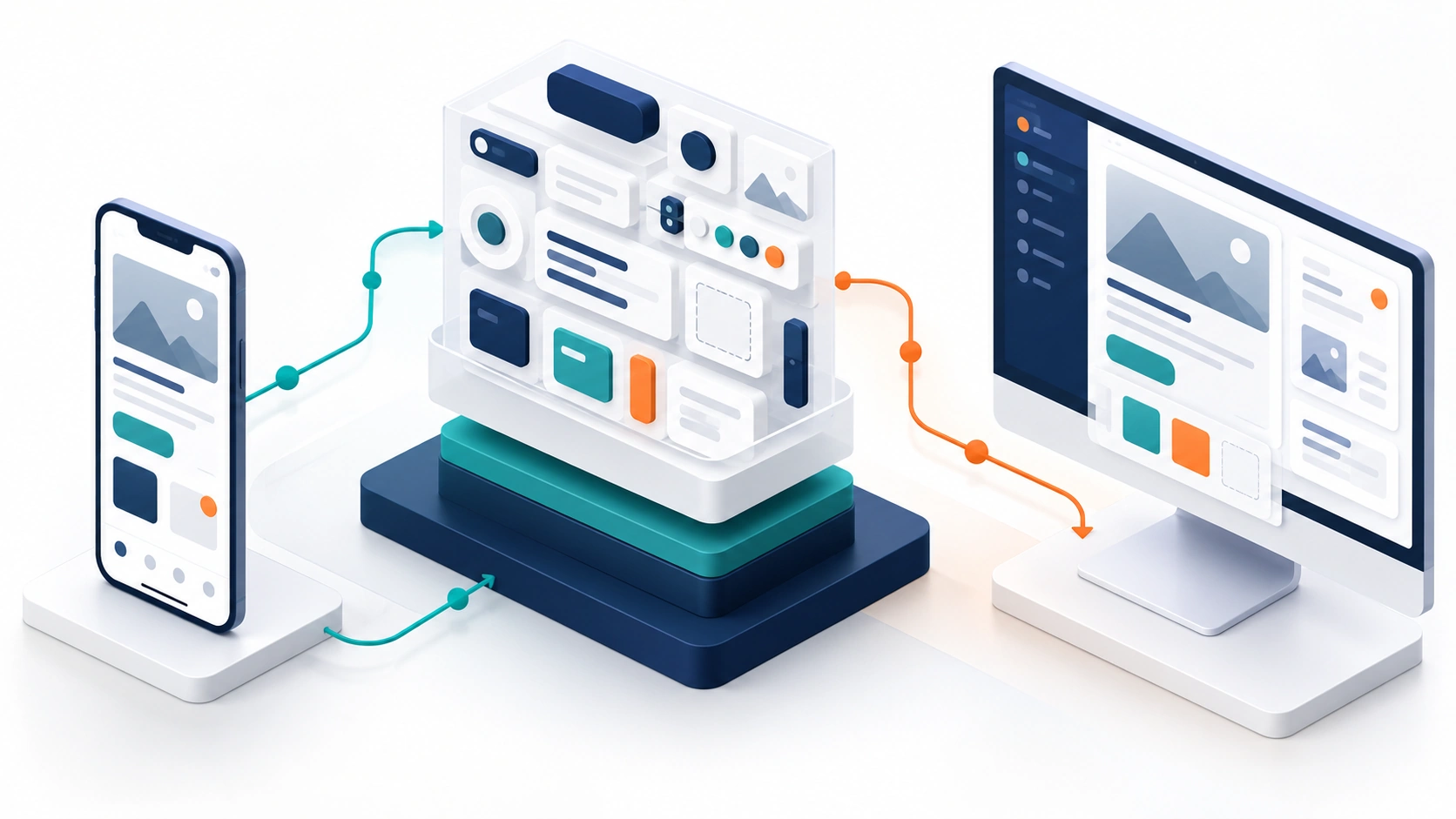
Original AI-generated editorial illustration; it depicts a concept rather than a client deployment or product screenshot.
Introduction
Repeated interface work creates more than visual inconsistency. Teams can implement the same form behaviour differently, making defects and accessibility fixes expensive to repeat. A design system earns its investment when it helps people build and maintain recurring product patterns with clear ownership. Here is how to evaluate design system against that business need.
What Is design system?
A design system is a maintained set of design principles, reusable components, tokens and usage guidance for creating consistent product experiences.
Repeated patterns should not require repeated decisions. Shared components can spread improvements or defects. Teams need guidance for contribution and change.
A component library alone is not a design system; guidance and maintenance make it dependable. The scope should make this distinction clear before the team commits to a solution.
Technical context: The GOV.UK Design System brings together styles, components and patterns with usage guidance. GOV.UK Design System
Why design system Matters
- Repeated patterns should not require repeated decisions.
- Shared components can spread improvements or defects.
- Teams need guidance for contribution and change.
How to Evaluate and Implement design system
Start with recurring product patterns
Inventory actual screens and workflows before building a large component library. Prioritise forms, navigation, tables and feedback patterns used repeatedly. Define tokens for typography, spacing and colour with meaningful usage rules. The objective is reliable product behaviour, not a gallery of every possible control. Keep distinctive product needs visible so consistency does not become a reason to force an unsuitable interaction.
Connect design and implementation
Agree component states, accessibility behaviour and responsive rules alongside visual specifications. Keep design files and coded components aligned through an explicit release process. Document loading, empty, error and disabled states. Test representative integrations because a component that works alone may fail inside a complex form. A shared name is not enough if designers and developers mean different behaviour by it.
Govern adoption and exceptions
Name maintainers and define how teams propose changes. Version components and explain breaking changes. Provide migration guidance for consuming products. Allow reviewed exceptions where the shared pattern does not fit, then decide whether the system should evolve. Measure whether teams actually use the system and whether it reduces repeated work. A library without ownership becomes another dependency that product teams avoid updating.
Compare the available approaches
| Approach | Suitable starting point | Main limitation or responsibility |
|---|---|---|
| Style guide | Visual rules | Limited implementation detail |
| Component library | Reusable coded controls | Needs usage and governance |
| Design system | Patterns, components and maintenance | Requires ongoing ownership |
A practical example
A hypothetical company maintains a dealer portal and an internal operations app. It begins with shared form fields, status labels and approval patterns rather than redesigning every screen. Fixes to validation and focus behaviour are released with migration notes. Teams retain separate layouts where their tasks differ. The rollout judges useful reuse and defect reduction without promising universal development-speed gains.
An acceptance test worth running
Implement a shared form pattern in two products, including errors, loading and keyboard behaviour. Release a component correction and have each team follow the migration guidance. Check whether design documentation and code still agree. A usable system should make the change understandable and controlled; it should not require every consuming team to discover the same undocumented difference independently.
What to measure
Track adoption, repeated implementation work, component defects, migration effort and accessibility regressions.
Use a representative baseline and record the conditions of the comparison. Agree who reviews failures and what evidence is needed before expanding the scope. For a broader view of the related delivery work, explore Webbies services.
Practical Steps for design system
- Inventory repeated patterns across real products.
- Define shared states and accessibility behaviour.
- Build and version high-use components first.
- Create contribution, migration and exception rules.
Prepare a useful project brief
| Decision | What to establish |
|---|---|
| Audience | teams maintaining several web and mobile products |
| First boundary to agree | Inventory repeated patterns across real products. |
| Evidence of useful performance | Track adoption, repeated implementation work, component defects, migration effort and accessibility regressions. |
| Estimate dependency | Product variation, platform coverage, existing inconsistency and governance requirements determine scope. |
Bring sample inputs and an example of an exception to the first discussion. Separate confirmed requirements from assumptions, and identify who can supply missing information. The brief should let a delivery team explain what it needs to investigate before making a detailed commitment.
Common Mistakes to Avoid
- Building a large library before validating demand.
- Ignoring error and loading states.
- Treating consistency as a reason to block justified differences.
Frequently Asked Questions
What does design system mean in a business project?
A design system is a maintained set of design principles, reusable components, tokens and usage guidance for creating consistent product experiences.
How should a team begin evaluating enterprise design system?
Inventory repeated patterns across real products. Define shared states and accessibility behaviour.
How do we measure whether UI component governance is useful?
Track adoption, repeated implementation work, component defects, migration effort and accessibility regressions.
What affects the cost or timeline of design system?
Product variation, platform coverage, existing inconsistency and governance requirements determine scope. A delivery estimate should follow a review of these dependencies.
What is a common misconception about design system?
A component library alone is not a design system; guidance and maintenance make it dependable.
Conclusion
A design system should make recurring product work easier to implement and maintain. Begin with real patterns and give the shared components an accountable lifecycle. Assess a practical design-system starting point with Webbies.
Sources and further reading
- GOV.UK Design System — primary technical reference, checked during research on 30 October 2026.
Discuss your project
Assess a practical design-system starting point. Share the current workflow, intended users, existing systems and the decision you need to make; the next step can be a 20–30 minute discovery discussion.