
Payment Reconciliation Automation: Match Orders, Settlements and Fees
TL;DR: Payment reconciliation automation matches commerce, payment-provider and bank records using defined rules and routes unresolved differences for review. Map transaction types, identifiers and settlement timing. A high automatic-match rate is not enough if the remaining differences are unexplained or material.
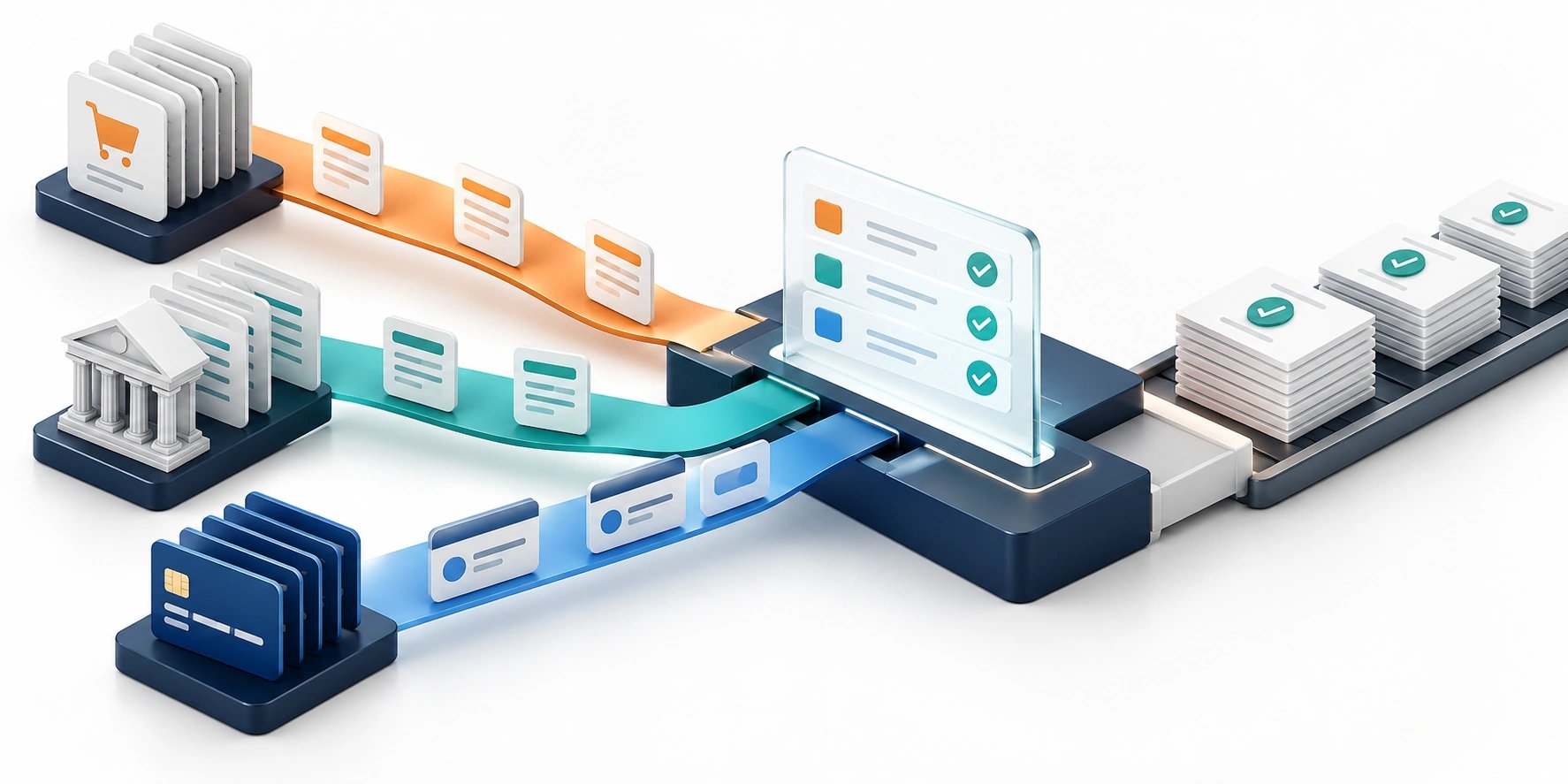
Original AI-generated editorial illustration; it depicts a concept rather than a client deployment or product screenshot.
Introduction
An order amount, a payment capture and a bank deposit describe different events. Fees, refunds, partial settlements and timing differences make simple spreadsheet matching unreliable. The first design task is to explain those differences, not to force every transaction into a one-to-one match. Here is how to evaluate payment reconciliation automation against that business need.
What Is payment reconciliation automation?
Payment reconciliation automation matches commerce, payment-provider and bank records using defined rules and routes unresolved differences for review.
One settlement may contain many transactions and deductions. Refunds and chargebacks can occur after the original sale. Unexplained differences need evidence and a review owner.
A high automatic-match rate is not enough if the remaining differences are unexplained or material. The scope should make this distinction clear before the team commits to a solution.
Technical context: Stripe documents reconciliation workflows for comparing payment activity and financial records. Stripe: Reconciliation
Why payment reconciliation automation Matters
- One settlement may contain many transactions and deductions.
- Refunds and chargebacks can occur after the original sale.
- Unexplained differences need evidence and a review owner.
How to Evaluate and Implement payment reconciliation automation
Define the records and matching keys
Inventory orders, payment attempts, captures, refunds, settlement batches and bank entries. Preserve their identifiers and timestamps rather than joining only on amount. Clarify gross and net values, fee treatment and settlement currency. Document how partial payments and split settlements appear in each source. A clean data model prevents a matching algorithm from hiding differences that finance needs to understand.
Use deterministic rules before ambiguous suggestions
Start with exact identifiers and documented settlement logic. Add tolerances only when finance approves their meaning. Separate confirmed matches from suggested matches and unresolved items. AI can help interpret unstructured statements or descriptions, but it should not silently approve a financial discrepancy. Preserve the rule and evidence that produced each match so staff can reproduce it during review.
Build an exception and closing process
Group differences by reason: timing, fee, missing transaction, duplicate or unsupported adjustment. Let reviewers inspect the original records and record a resolution. Define how late data reopens or updates a previously closed period. Prevent retries from creating duplicate accounting entries. The system should produce an explainable reconciliation position and an accountable exception queue, not only a green completion indicator.
Compare the available approaches
| Approach | Suitable starting point | Main limitation or responsibility |
|---|---|---|
| Amount-only matching | Simple homogeneous records | High ambiguity with repeated amounts |
| Rule-based reconciliation | Stable references and settlement logic | Requires maintained provider mappings |
| AI-assisted interpretation | Variable statements or descriptions | Human and rule validation remain necessary |
A practical example
A hypothetical online retailer receives a net settlement containing captures, fees and refunds. The system links transactions through provider references, calculates the expected net amount and compares it with the bank entry. A missing refund remains an exception until the relevant record arrives or finance resolves it. The example describes a workflow design, not accounting advice or a claimed reduction in reconciliation effort.
An acceptance test worth running
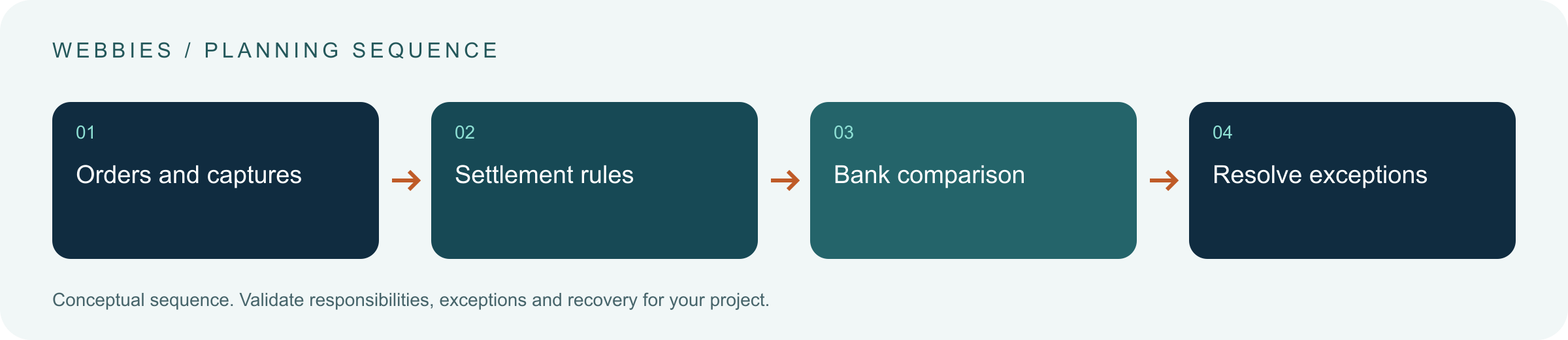
Use a settlement containing partial captures, fees and a refund from an earlier period. Compare the expected net value with a bank entry and leave one source record missing. The result should retain an explainable exception. Add the late record and check how the previous match is updated without duplicating accounting entries or silently rewriting the review history.
What to measure
Track confirmed matches, aged exceptions, unexplained differences, reviewer effort and duplicate-entry prevention.
Use a representative baseline and record the conditions of the comparison. Agree who reviews failures and what evidence is needed before expanding the scope. For a broader view of the related delivery work, explore Webbies services.
Practical Steps for payment reconciliation automation
- Map transaction types, identifiers and settlement timing.
- Agree matching rules and tolerances with finance.
- Create reason-based exceptions with original evidence.
- Test late refunds, duplicates and reopened reporting periods.
Prepare a useful project brief
| Decision | What to establish |
|---|---|
| Audience | finance teams reconciling commerce and payment data |
| First boundary to agree | Map transaction types, identifiers and settlement timing. |
| Evidence of useful performance | Track confirmed matches, aged exceptions, unexplained differences, reviewer effort and duplicate-entry prevention. |
| Estimate dependency | Provider count, transaction variety, statement quality and accounting-system integration drive scope. |
Bring sample inputs and an example of an exception to the first discussion. Separate confirmed requirements from assumptions, and identify who can supply missing information. The brief should let a delivery team explain what it needs to investigate before making a detailed commitment.
Common Mistakes to Avoid
- Treating bank deposits as identical to order revenue.
- Automatically clearing differences without an approved rule.
- Ignoring late adjustments after a period is closed.
Frequently Asked Questions
What does payment reconciliation automation mean in a business project?
Payment reconciliation automation matches commerce, payment-provider and bank records using defined rules and routes unresolved differences for review.
How should a team begin evaluating order settlement matching?
Map transaction types, identifiers and settlement timing. Agree matching rules and tolerances with finance.
How do we measure whether finance reconciliation software is useful?
Track confirmed matches, aged exceptions, unexplained differences, reviewer effort and duplicate-entry prevention.
What affects the cost or timeline of payment reconciliation automation?
Provider count, transaction variety, statement quality and accounting-system integration drive scope. A delivery estimate should follow a review of these dependencies.
What is a common misconception about payment reconciliation automation?
A high automatic-match rate is not enough if the remaining differences are unexplained or material.
Conclusion
Reconciliation software should explain matches and unresolved differences. Preserve the evidence and finance ownership rather than optimising an automatic-match percentage in isolation. Assess a reconciliation automation workflow with Webbies.
Sources and further reading
- Stripe: Reconciliation — primary technical reference, checked during research on 30 October 2026.
Discuss your project
Assess a reconciliation automation workflow. Share the current workflow, intended users, existing systems and the decision you need to make; the next step can be a 20–30 minute discovery discussion.