Factory Floor Tracking: Turn Camera Events Into Useful Decisions
TL;DR: Factory floor tracking converts observations from cameras or other sensors into defined events about movement or presence within a production environment. Choose one operational question and event definition. A camera-based tracking demo does not prove that a system can measure every production activity accurately.
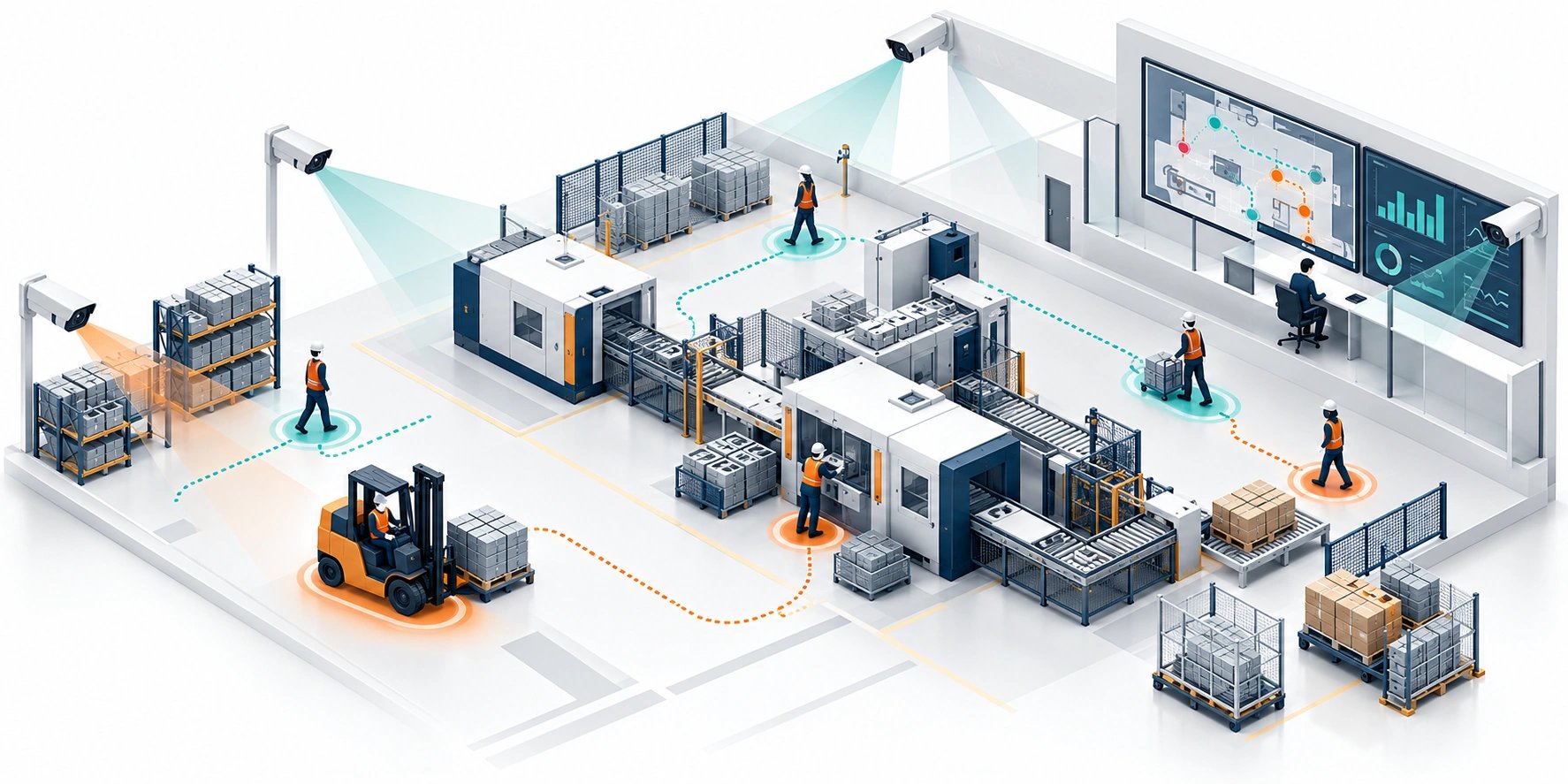
Original AI-generated editorial illustration; it depicts a concept rather than a client deployment or product screenshot.
Introduction
A camera can record movement without answering a useful production question. Tracking becomes valuable when an event has a clear definition and an operations owner knows how to respond. Begin with a bounded area and a measurable question, rather than trying to infer the entire factory's productivity from video. Here is how to evaluate factory floor tracking against that business need.
What Is factory floor tracking?
Factory floor tracking converts observations from cameras or other sensors into defined events about movement or presence within a production environment.
Occlusion and changing conditions affect track continuity. Movement is not the same as productive work. Operational events require context and accountable interpretation.
A camera-based tracking demo does not prove that a system can measure every production activity accurately. The scope should make this distinction clear before the team commits to a solution.
Technical context: OpenCV documents motion estimation and tracking of image features across video frames. OpenCV: Optical flow and motion analysis
Why factory floor tracking Matters
- Occlusion and changing conditions affect track continuity.
- Movement is not the same as productive work.
- Operational events require context and accountable interpretation.
How to Evaluate and Implement factory floor tracking
Define the event before the model
Specify the zone, object class and event the system should record. An entry, dwell interval and transfer between stations are different observations. Agree how incomplete visibility and ambiguous movement are handled. Avoid labelling camera-derived presence as productivity without process evidence. The initial pilot should answer a narrow operations question that can be checked against human observation.
Test the physical environment
Review camera angles, occlusion, lighting and changes in layout. Define how tracks are created, lost and reconciled. Test shift changes and crowded periods, not just an empty demonstration floor. Decide whether processing belongs near the camera or in a central service. Document capture limitations so dashboard users do not mistake missing observations for a lack of activity.
Connect events to a useful review
Show timestamps, confidence or quality indicators where meaningful, and the limits of the event definition. Establish appropriate privacy, access and retention practices with qualified local review. Prefer the minimum data needed for the operational purpose. Give staff a way to challenge incorrect events. A dashboard should support decisions about a process rather than silently becoming an unsupported worker-performance scoring system.
Compare the available approaches
| Approach | Suitable starting point | Main limitation or responsibility |
|---|---|---|
| Manual observation | Context-rich process sampling | Limited continuous coverage |
| Camera events | Defined visual movement observations | Occlusion and interpretation limits |
| Sensor events | Instrumented equipment or checkpoints | Hardware and integration requirements |
A practical example
A hypothetical manufacturer tests movement between two material-transfer zones. Reviewers compare recorded crossings with sampled observation and investigate missed events caused by stacked items. The pilot does not identify individual workers or claim to measure overall efficiency. It determines whether the chosen event can be observed reliably enough to support a specific material-flow discussion.
An acceptance test worth running
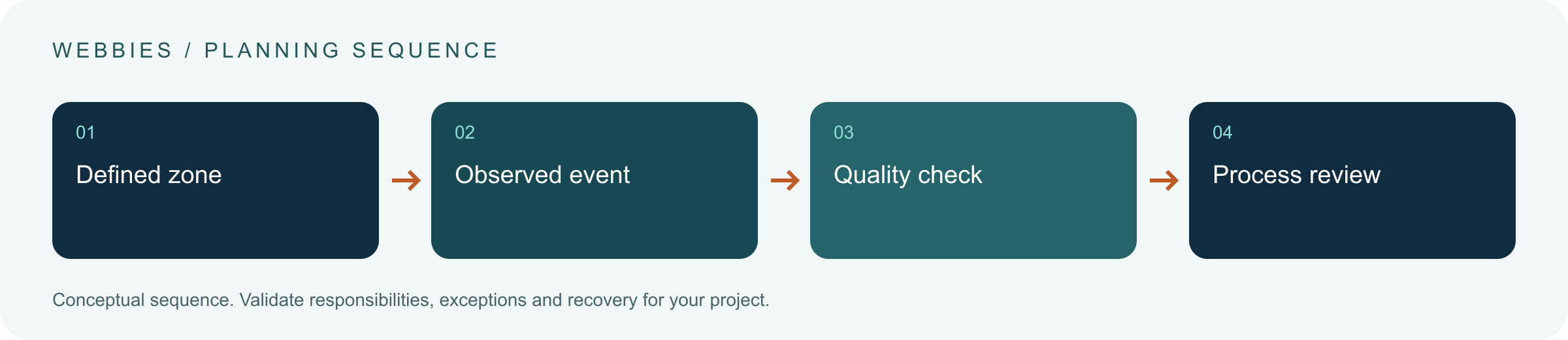
Observe the selected zone during quiet and crowded periods and compare sampled events with manual review. Introduce an occlusion and label the resulting uncertainty. Ask operations whether the event answers the chosen question. If the dashboard encourages conclusions about productivity that the event cannot support, revise the metric and language before widening the deployment.
What to measure
Measure event precision, missed events, track continuity, coverage gaps and usefulness for the chosen process decision.
Use a representative baseline and record the conditions of the comparison. Agree who reviews failures and what evidence is needed before expanding the scope. For a broader view of the related delivery work, explore Webbies services.
Practical Steps for factory floor tracking
- Choose one operational question and event definition.
- Survey visibility and capture constraints.
- Validate against representative observation.
- Agree access, retention and how staff act on results.
Prepare a useful project brief
| Decision | What to establish |
|---|---|
| Audience | plant and operations teams evaluating camera-derived events |
| First boundary to agree | Choose one operational question and event definition. |
| Evidence of useful performance | Measure event precision, missed events, track continuity, coverage gaps and usefulness for the chosen process decision. |
| Estimate dependency | Site layout, camera coverage, event complexity, data governance and dashboard integration determine scope. |
Bring sample inputs and an example of an exception to the first discussion. Separate confirmed requirements from assumptions, and identify who can supply missing information. The brief should let a delivery team explain what it needs to investigate before making a detailed commitment.
Common Mistakes to Avoid
- Equating motion with productivity.
- Ignoring occluded periods.
- Expanding surveillance without a defined purpose.
Frequently Asked Questions
What does factory floor tracking mean in a business project?
Factory floor tracking converts observations from cameras or other sensors into defined events about movement or presence within a production environment.
How should a team begin evaluating factory computer vision tracking?
Choose one operational question and event definition. Survey visibility and capture constraints.
How do we measure whether production movement analytics is useful?
Measure event precision, missed events, track continuity, coverage gaps and usefulness for the chosen process decision.
What affects the cost or timeline of factory floor tracking?
Site layout, camera coverage, event complexity, data governance and dashboard integration determine scope. A delivery estimate should follow a review of these dependencies.
What is a common misconception about factory floor tracking?
A camera-based tracking demo does not prove that a system can measure every production activity accurately.
Conclusion
Factory tracking should answer a bounded process question with understood event limits. Keep visibility gaps and interpretation separate from unsupported productivity conclusions. Assess a bounded factory-tracking use case with Webbies.
Sources and further reading
- OpenCV: Optical flow and motion analysis — primary technical reference, checked during research on 30 October 2026.
Discuss your project
Assess a bounded factory-tracking use case. Share the current workflow, intended users, existing systems and the decision you need to make; the next step can be a 20–30 minute discovery discussion.