Edge AI vs Cloud AI: Choose Where Business Inference Runs
TL;DR: Edge AI vs cloud AI is a deployment choice between running inference near the data-generating device and running it in a remotely managed computing environment. Define latency, connectivity and data constraints. There is no universal winner; the correct deployment depends on operating conditions and ownership.
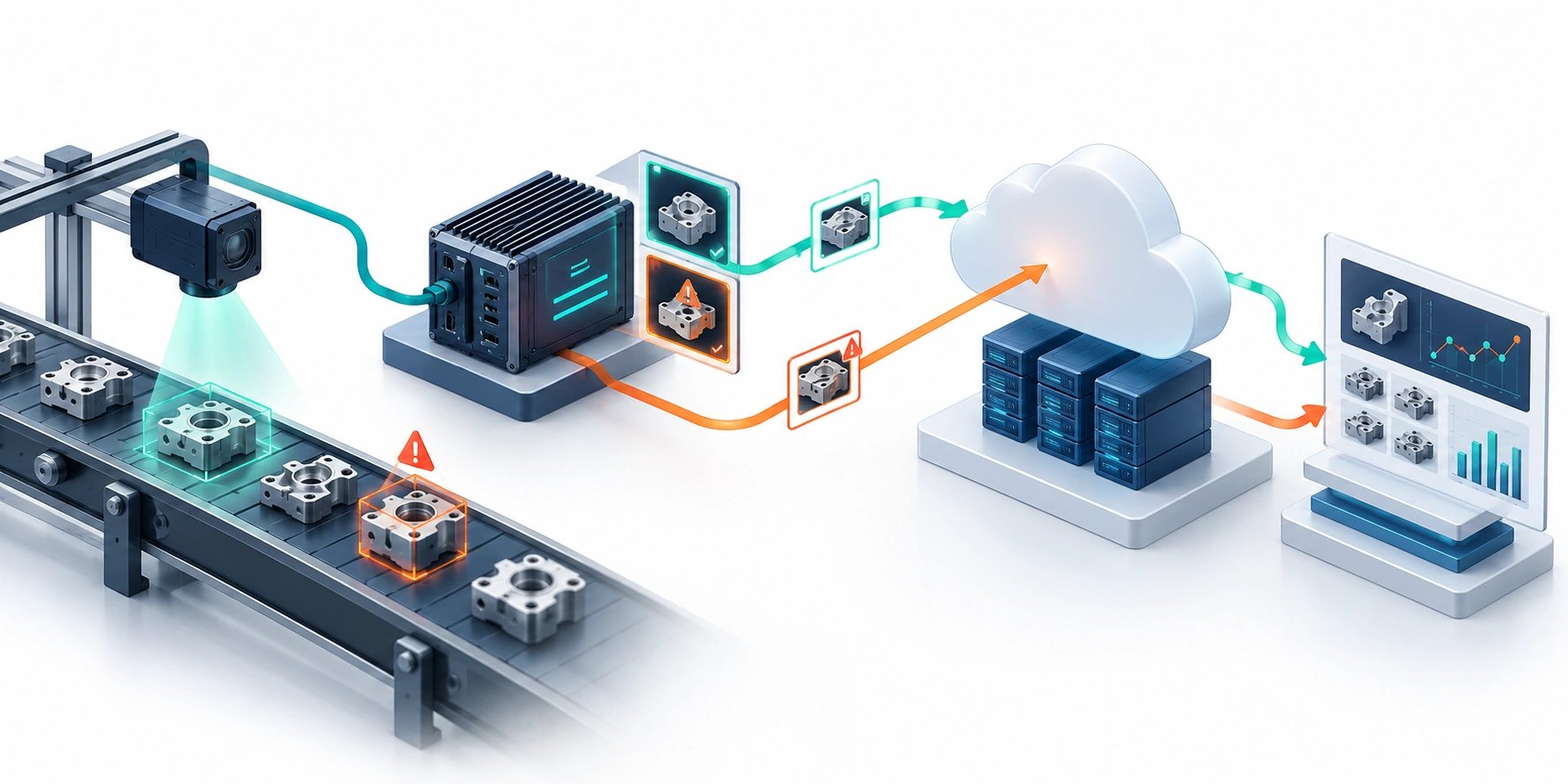
Original AI-generated editorial illustration; it depicts a concept rather than a client deployment or product screenshot.
Introduction
Where inference runs changes latency, bandwidth, support and failure behaviour. Processing near a camera may help during network interruptions, while central processing can simplify updates. Compare the complete deployment, including the people who must maintain hardware and investigate failures at each site. Here is how to evaluate edge AI vs cloud AI against that business need.
What Is edge AI vs cloud AI?
Edge AI vs cloud AI is a deployment choice between running inference near the data-generating device and running it in a remotely managed computing environment.
Network availability affects remote inference. Local hardware introduces maintenance and capacity limits. Data movement and update control influence the architecture.
There is no universal winner; the correct deployment depends on operating conditions and ownership. The scope should make this distinction clear before the team commits to a solution.
Technical context: Microsoft documents local inference and model-update considerations for edge devices. Microsoft: Machine learning inference on an IoT Edge device
Why edge AI vs cloud AI Matters
- Network availability affects remote inference.
- Local hardware introduces maintenance and capacity limits.
- Data movement and update control influence the architecture.
How to Evaluate and Implement edge AI vs cloud AI
Start with operating constraints
State response-time needs, image volume, connectivity and the consequences of interruption. Identify information that must remain local and validate the applicable requirements. Measure the complete path from capture to decision rather than model time alone. Avoid assuming that local processing is automatically private or that cloud processing is always too slow. The actual data path and controls determine the result.
Compare lifecycle responsibilities
For edge deployments, include device provisioning, thermal conditions, updates, physical access and replacement. For cloud deployments, include network costs, availability, identity and service limits. Test representative hardware under sustained use. A laptop demonstration does not establish that a small device can meet production demand. Assign responsibility for failed updates and devices that stop reporting.
Consider a deliberate hybrid
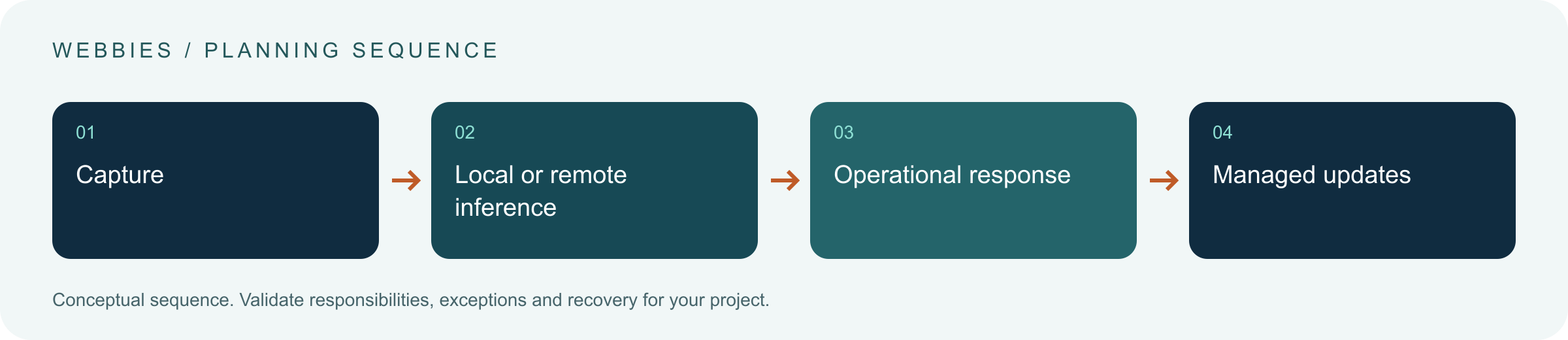
A device may perform immediate inference while a central service handles monitoring, aggregate analysis and approved model distribution. Define which data travels and what happens when central services are unavailable. Keep model and configuration versions visible. Test rollback and resynchronisation. Hybrid designs can be useful, but they add boundaries that need explicit ownership rather than magically combining the benefits of both options.
Compare the available approaches
| Approach | Suitable starting point | Main limitation or responsibility |
|---|---|---|
| Edge inference | Local response and selected data handling | Hardware support and capacity |
| Cloud inference | Central management and elastic resources | Connectivity and data-transfer dependence |
| Hybrid | Split immediate and central tasks | Version and synchronisation complexity |
A practical example
A hypothetical factory pilot tests local inspection to reduce dependence on a variable connection. The central service receives selected events and manages approved model versions. If connectivity fails, local results remain available with a visible reporting delay. The team measures hardware stability and recovery before choosing the architecture. No latency or cost advantage is assumed without testing.
An acceptance test worth running
Benchmark capture-to-response latency under normal connectivity and a sustained outage. Update a model on representative edge hardware and simulate an interrupted update. Inspect version reporting, rollback and retained events. Compare the support workload with a cloud candidate. The decision should document where each responsibility sits rather than assuming that local inference removes the need for central operational management.
What to measure
Track end-to-end latency, availability, bandwidth, sustained performance and update recovery.
Use a representative baseline and record the conditions of the comparison. Agree who reviews failures and what evidence is needed before expanding the scope. For a broader view of the related delivery work, explore Webbies services.
Practical Steps for edge AI vs cloud AI
- Define latency, connectivity and data constraints.
- Benchmark the full path on candidate infrastructure.
- Assign updates, monitoring and hardware support.
- Test outages, rollback and recovery before deployment.
Prepare a useful project brief
| Decision | What to establish |
|---|---|
| Audience | engineering leaders deploying camera or device intelligence |
| First boundary to agree | Define latency, connectivity and data constraints. |
| Evidence of useful performance | Track end-to-end latency, availability, bandwidth, sustained performance and update recovery. |
| Estimate dependency | Hardware, site support, cloud usage, networking and model lifecycle responsibilities drive the comparison. |
Bring sample inputs and an example of an exception to the first discussion. Separate confirmed requirements from assumptions, and identify who can supply missing information. The brief should let a delivery team explain what it needs to investigate before making a detailed commitment.
Common Mistakes to Avoid
- Comparing only model inference time.
- Ignoring device maintenance.
- Assuming deployment location guarantees privacy.
Frequently Asked Questions
What does edge AI vs cloud AI mean in a business project?
Edge AI vs cloud AI is a deployment choice between running inference near the data-generating device and running it in a remotely managed computing environment.
How should a team begin evaluating edge inference architecture?
Define latency, connectivity and data constraints. Benchmark the full path on candidate infrastructure.
How do we measure whether cloud AI deployment is useful?
Track end-to-end latency, availability, bandwidth, sustained performance and update recovery.
What affects the cost or timeline of edge AI vs cloud AI?
Hardware, site support, cloud usage, networking and model lifecycle responsibilities drive the comparison. A delivery estimate should follow a review of these dependencies.
What is a common misconception about edge AI vs cloud AI?
There is no universal winner; the correct deployment depends on operating conditions and ownership.
Conclusion
Inference placement is an operating decision as well as an architecture choice. Compare latency, updates, connectivity and site support using the complete deployed path. Compare edge and cloud deployment options with Webbies.
Sources and further reading
- Microsoft: Machine learning inference on an IoT Edge device — primary technical reference, checked during research on 30 October 2026.
Discuss your project
Compare edge and cloud deployment options. Share the current workflow, intended users, existing systems and the decision you need to make; the next step can be a 20–30 minute discovery discussion.