
Digital Transformation in Nepal: A Roadmap for Growing Businesses
TL;DR: Digital transformation in Nepal is the planned improvement of business workflows and customer experiences through appropriate software, connected information and organisational change. Map a repeated cross-team problem and its owner. Transformation does not require replacing every tool at once; a focused, supported process change can be the right start.

Original AI-generated editorial illustration; it depicts a concept rather than a client deployment or product screenshot.
Introduction
A growing business can outgrow spreadsheets long before it needs a large replacement platform. Branch orders, stock updates and customer enquiries may become disconnected as operations expand. A practical transformation roadmap begins with one shared process and the data required to run it dependably. Here is how to evaluate digital transformation in Nepal against that business need.
What Is digital transformation in Nepal?
Digital transformation in Nepal is the planned improvement of business workflows and customer experiences through appropriate software, connected information and organisational change.
Expansion creates additional handoffs and data copies. Staff adoption determines whether a new system is useful. Local operational requirements need explicit validation.
Transformation does not require replacing every tool at once; a focused, supported process change can be the right start. The scope should make this distinction clear before the team commits to a solution.
Technical context: Webbies' service overview describes websites, apps, AI and connected experiences. Webbies: Services
Why digital transformation in Nepal Matters
- Expansion creates additional handoffs and data copies.
- Staff adoption determines whether a new system is useful.
- Local operational requirements need explicit validation.
How to Evaluate and Implement digital transformation in Nepal
Choose an operational problem first
Map one process across branches, such as stock visibility, booking requests or quotation follow-up. Identify where information is re-entered and where decisions wait. Ask staff which records they trust. A business may need better ownership and a focused integration before a broad enterprise platform. Write a measurable outcome and name the manager responsible for the process.
Design for the actual working environment
Check devices, connectivity, language needs and staff availability. Validate local payment, tax and reporting integrations with qualified owners and current provider documentation. Do not assume requirements from another country apply unchanged. Where offline operation is necessary, show freshness and synchronisation status. The system should support how staff work while improving the process, rather than digitising every existing inconvenience.
Sequence change and ongoing support
Start with a branch or workflow where the business can provide feedback and maintain the data. Prepare migration, training and support alongside development. Keep manual fallback responsibilities clear during rollout. Webbies' internal market focus includes Nepal, while its public studio base is Kolkata; a project discussion should establish delivery arrangements and local coordination rather than imply an unverified Nepal office.
Compare the available approaches
| Approach | Suitable starting point | Main limitation or responsibility |
|---|---|---|
| Spreadsheet improvement | Small, stable process | Limited multi-team control |
| Connected applications | Existing tools with clearer handoffs | Integration and ownership work |
| Custom platform | Distinctive multi-branch workflow | Requires sustained product support |
A practical example
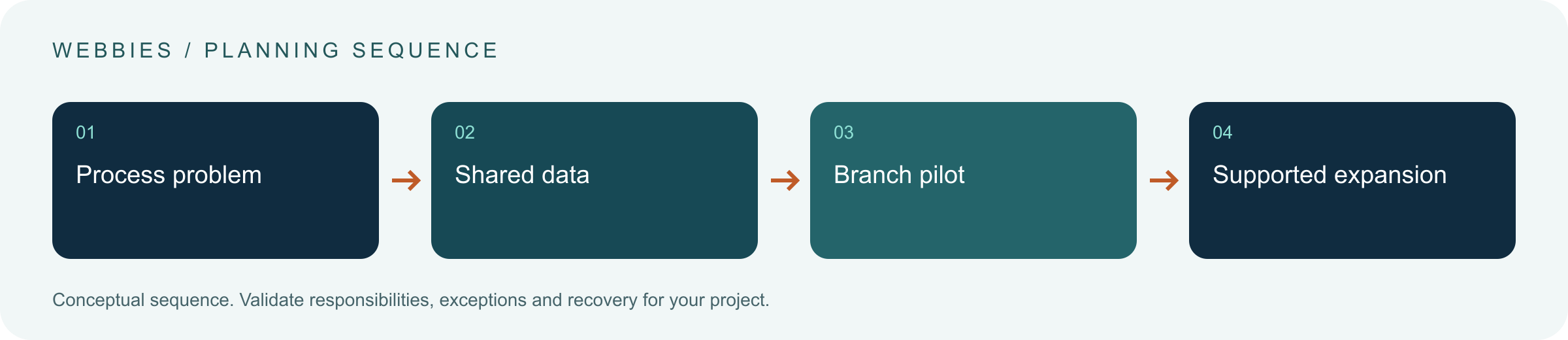
A hypothetical Kathmandu Valley retailer begins with a shared product catalogue and branch stock enquiry process. Order acceptance remains with the existing operations team until data and handoffs are dependable. A second phase can evaluate ordering or payments using verified local requirements. The staged approach tests adoption and ownership before expanding the platform across more locations.
An acceptance test worth running
Pilot the selected cross-branch workflow using the staff devices and data actually available. Include incomplete records and a connectivity interruption. Ask the process owner to reconcile the result with the current business records. Validate local integration assumptions separately. Expand only after the team can maintain the data and recover failures without depending on an informal spreadsheet outside the agreed process.
What to measure
Track repeated entry, branch consistency, successful tasks, adoption and support demand.
Use a representative baseline and record the conditions of the comparison. Agree who reviews failures and what evidence is needed before expanding the scope. For a broader view of the related delivery work, explore Webbies services.
Practical Steps for digital transformation in Nepal
- Map a repeated cross-team problem and its owner.
- Validate devices, data and local integration requirements.
- Pilot one workflow with training and fallback.
- Expand after checking adoption and operational consistency.
Prepare a useful project brief
| Decision | What to establish |
|---|---|
| Audience | growing Nepal businesses with multiple teams or branches |
| First boundary to agree | Map a repeated cross-team problem and its owner. |
| Evidence of useful performance | Track repeated entry, branch consistency, successful tasks, adoption and support demand. |
| Estimate dependency | Branch variation, migration, integrations, training and support arrangements determine scope. |
Bring sample inputs and an example of an exception to the first discussion. Separate confirmed requirements from assumptions, and identify who can supply missing information. The brief should let a delivery team explain what it needs to investigate before making a detailed commitment.
Common Mistakes to Avoid
- Buying a large system before mapping the process.
- Assuming staff will maintain undefined data fields.
- Making unverified claims about local compliance or payment support.
Frequently Asked Questions
What does digital transformation in Nepal mean in a business project?
Digital transformation in Nepal is the planned improvement of business workflows and customer experiences through appropriate software, connected information and organisational change.
How should a team begin evaluating business software Nepal?
Map a repeated cross-team problem and its owner. Validate devices, data and local integration requirements.
How do we measure whether Kathmandu digital transformation is useful?
Track repeated entry, branch consistency, successful tasks, adoption and support demand.
What affects the cost or timeline of digital transformation in Nepal?
Branch variation, migration, integrations, training and support arrangements determine scope. A delivery estimate should follow a review of these dependencies.
What is a common misconception about digital transformation in Nepal?
Transformation does not require replacing every tool at once; a focused, supported process change can be the right start.
Conclusion
A practical Nepal transformation roadmap improves one owned process before widening the platform. Validate local requirements and staff adoption alongside the technical build. Discuss a Nepal business-software roadmap with Webbies.
Sources and further reading
- Webbies: Services — primary technical reference, checked during research on 30 October 2026.
Discuss your project
Discuss a Nepal business-software roadmap. Share the current workflow, intended users, existing systems and the decision you need to make; the next step can be a 20–30 minute discovery discussion.