
AI Evaluation: What to Measure Before Business Deployment
TL;DR: AI evaluation is the systematic assessment of an AI application's outputs, actions and failure behaviour against task-specific acceptance criteria. Define the business task and unacceptable failures. A high benchmark score does not prove that an application is ready for your documents, users or business permissions.
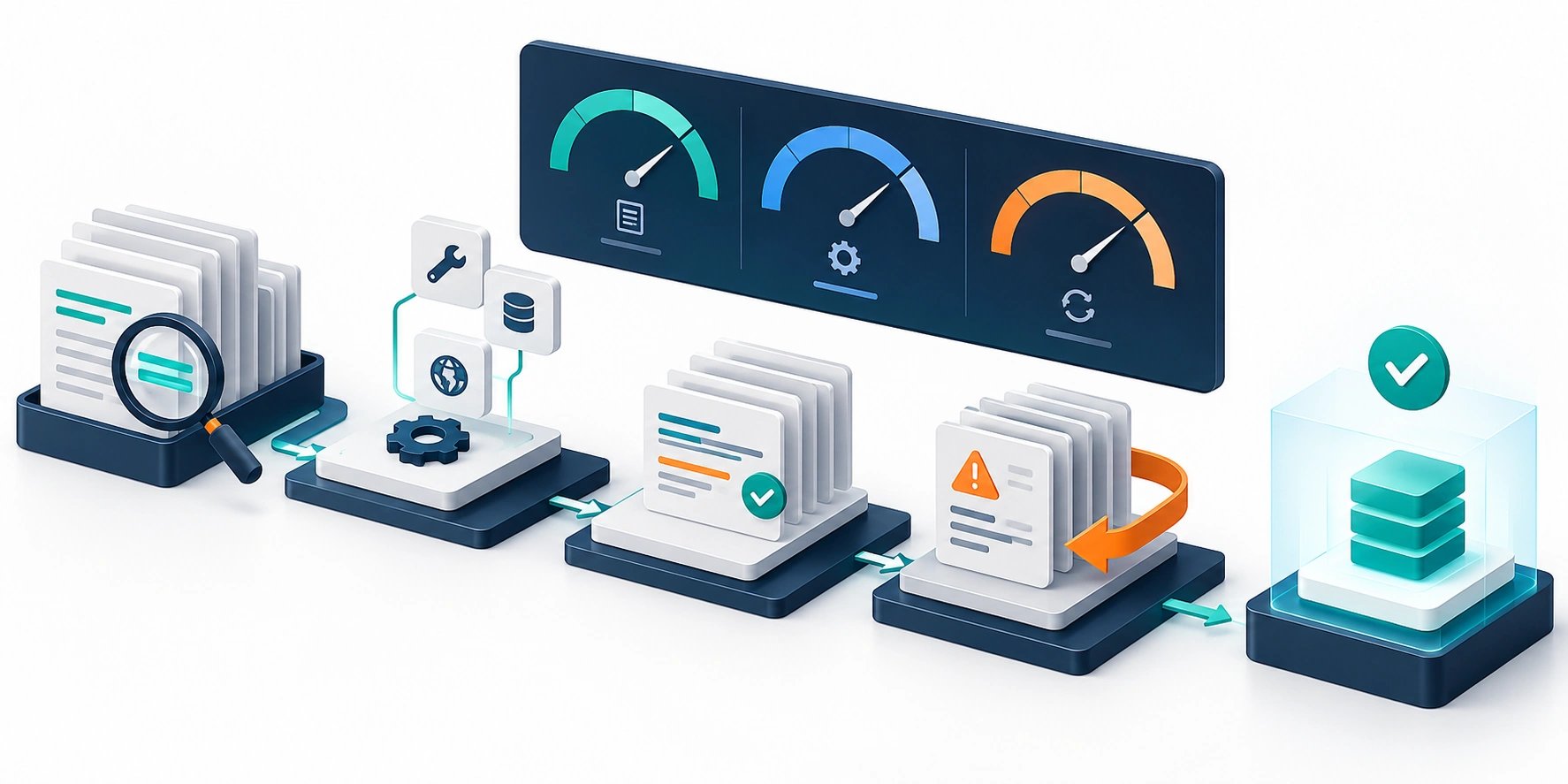
Original AI-generated editorial illustration; it depicts a concept rather than a client deployment or product screenshot.
Introduction
A model can produce a polished answer that cites the wrong paragraph, calls the wrong tool or ignores an important exception. Business evaluation needs to identify those failures separately. A single score is useful only when the team can explain which tasks, risks and operating conditions it represents. Here is how to evaluate AI evaluation against that business need.
What Is AI evaluation?
AI evaluation is the systematic assessment of an AI application's outputs, actions and failure behaviour against task-specific acceptance criteria.
Fluent language can hide incorrect evidence and business actions. Average scores can conceal failure on a critical class of requests. Model and document changes can alter behaviour after launch.
A high benchmark score does not prove that an application is ready for your documents, users or business permissions. The scope should make this distinction clear before the team commits to a solution.
Technical context: Google documents task-oriented evaluation of generative AI applications. Google Cloud: Gen AI evaluation overview
Why AI evaluation Matters
- Fluent language can hide incorrect evidence and business actions.
- Average scores can conceal failure on a critical class of requests.
- Model and document changes can alter behaviour after launch.
How to Evaluate and Implement AI evaluation
Build a test set around business cases
Collect representative requests with appropriate data controls, then add missing-information, adversarial and unsupported cases. Have domain reviewers define the expected outcome and the conditions for refusing or escalating. Split development cases from a held-out evaluation set. Record the source version and system configuration for each run. This makes a later performance change interpretable rather than just a different score on an undocumented collection.
Score the layers independently
For a knowledge assistant, examine retrieval relevance, citation support and final-answer correctness. For a tool-using workflow, also examine identity, tool arguments, execution receipts and resulting state. Measure latency and cost under realistic concurrency. A system that answers correctly but cannot meet the service's response expectations may still be unsuitable. Keep automated checks for structural requirements and use qualified reviewers for judgements that require domain context.
Turn the result into a release decision
Agree thresholds and unacceptable failure types before looking at the final results. A permission breach should not disappear into a high average accuracy. Review disputed cases and document the limits of model-based grading if it is used. After release, sample real outcomes and feed newly discovered failures into regression tests. The test set should evolve with the workflow while preserving a stable reference set for comparing changes.
Compare the available approaches
| Approach | Suitable starting point | Main limitation or responsibility |
|---|---|---|
| Output checks | Required fields and valid formats | Cannot establish factual support alone |
| Domain review | Task correctness and useful escalation | Needs consistent reviewer guidance |
| Operational tests | Latency, failures and recovery | Must reflect deployment conditions |
A practical example
Consider an internal policy assistant. Reviewers score whether it finds the applicable policy, quotes or summarises it correctly and refuses access to restricted material. A question with no supported answer should produce a clear limitation, not a plausible invention. A successful test run includes those refusals. The example illustrates an evaluation design; it does not claim any particular accuracy level or production performance.
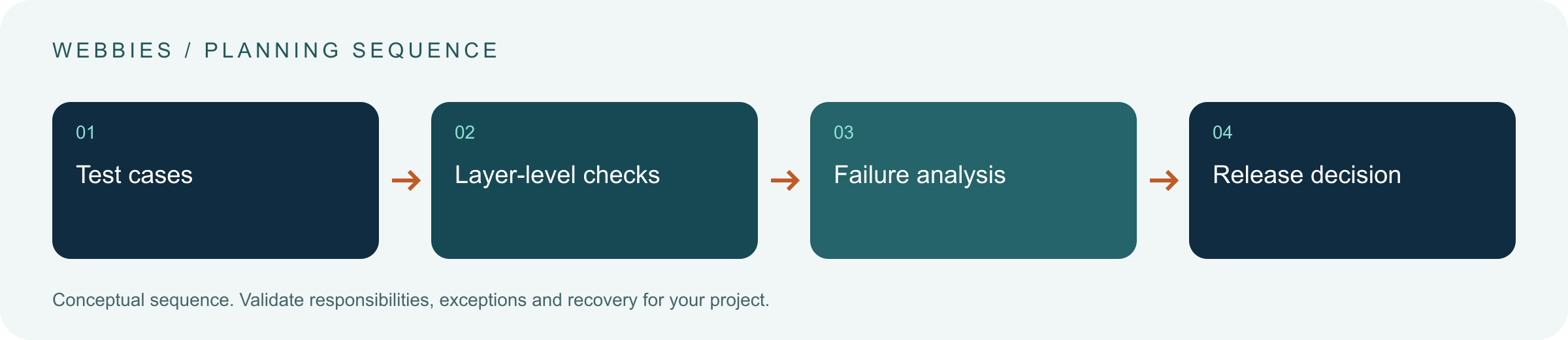
An acceptance test worth running
Change one source document or tool contract, rerun the fixed evaluation set and inspect the changed results by category. Include a case that should be refused, not answered. Ask reviewers to explain disagreements using the rubric. Preserve the configuration and sample details alongside the report so a release decision is reproducible and a later regression can be investigated.
What to measure
Report category-level correctness, unsupported answers, unsafe action attempts, handoff quality, latency and cost per verified task.
Use a representative baseline and record the conditions of the comparison. Agree who reviews failures and what evidence is needed before expanding the scope. For a broader view of the related delivery work, explore Webbies services.
Practical Steps for AI evaluation
- Define the business task and unacceptable failures.
- Prepare representative cases with reviewer-labelled outcomes.
- Evaluate evidence, actions and operations as separate dimensions.
- Set release gates and rerun the suite after material changes.
Prepare a useful project brief
| Decision | What to establish |
|---|---|
| Audience | product and engineering leaders approving business AI releases |
| First boundary to agree | Define the business task and unacceptable failures. |
| Evidence of useful performance | Report category-level correctness, unsupported answers, unsafe action attempts, handoff quality, latency and cost per verified task. |
| Estimate dependency | Domain-expert review, test coverage, permission scenarios and reproducible environments are key evaluation cost drivers. |
Bring sample inputs and an example of an exception to the first discussion. Separate confirmed requirements from assumptions, and identify who can supply missing information. The brief should let a delivery team explain what it needs to investigate before making a detailed commitment.
Common Mistakes to Avoid
- Evaluating only on the examples used to improve the prompt.
- Letting a model grade its own output without calibration.
- Reporting an average without failure categories or sample context.
Frequently Asked Questions
What does AI evaluation mean in a business project?
AI evaluation is the systematic assessment of an AI application's outputs, actions and failure behaviour against task-specific acceptance criteria.
How should a team begin evaluating LLM evaluation framework?
Define the business task and unacceptable failures. Prepare representative cases with reviewer-labelled outcomes.
How do we measure whether AI acceptance testing is useful?
Report category-level correctness, unsupported answers, unsafe action attempts, handoff quality, latency and cost per verified task.
What affects the cost or timeline of AI evaluation?
Domain-expert review, test coverage, permission scenarios and reproducible environments are key evaluation cost drivers. A delivery estimate should follow a review of these dependencies.
What is a common misconception about AI evaluation?
A high benchmark score does not prove that an application is ready for your documents, users or business permissions.
Conclusion
Release AI against task-specific evidence, including correct refusal and safe recovery. Keep evaluations reproducible so later changes can be judged against the same business expectations. Define acceptance criteria for an AI release with Webbies.
Sources and further reading
- Google Cloud: Gen AI evaluation overview — primary technical reference, checked during research on 30 October 2026.
Discuss your project
Define acceptance criteria for an AI release. Share the current workflow, intended users, existing systems and the decision you need to make; the next step can be a 20–30 minute discovery discussion.